


What happens if none of the Proposed Motions are passed?
If no Proposed Motions pass, then the membership fees agreed at the 38th World Conference in 2023 will remain in operation.
What happens if some of the Proposed Motions don’t pass? Does it mean they will all fail?
The Proposed Motions will be voted on independently to maximise MOs’ democratic voice.
Whist the World Board recommended Proposed Motions 1.1 to 1.9 be adopted (essentially, as a package), they are enabling MOs to express their preference on each Proposed Motion independently.
This means that it is technically possible for one, some, or all Proposed Motions to be passed.
Why is the World Board recommending so many Proposed Motions covering so many adjustments?
The consultation identified several areas that could be improved. The World Board felt it was important to offer MOs the chance to vote on each recommendation, rather than presenting them as a package.
Does the World Board have a preference on whether Proposed Motion 2 is adopted?
Proposed Motion 2 enables MOs to express their preference between the existing Rate-per-Member and the alternative Census Band methodologies.
As happened in 2011 (the last time a major review of the membership fee model took place), the World Board are providing a choice between two different fee methodologies.
Both Fee Models can deliver a similar level of income (c. £1.6 million GBP); meet the membership fee principles; and have several advantages and disadvantages. Therefore, the World Board finds both Models acceptable and can operate with either outcome, as decided by the EGM.
The reason that Proposed Motion 2 is drafted as a vote on the Census Band Fee Model (‘The Extraordinary General Meeting adopts the Census Band fee calculation methodology’) is because procedurally it is the simplest way to conduct the vote. It does not indicate any preference from the World Board for this Model.
The current Rate-per-member methodology (subject to any changes adopted in Proposed Motions 1.1-1.9 at the EGM) will automatically remain if MOs choose not to adopt Proposed Motion 2.
Therefore, if an MO’s preference is to maintain the Rate-per-member Fee Model, they should vote ‘No’ or ‘Against’ to Proposed Motion 2.
Is the total income generated from membership fees sufficient to support a sustainable WAGGGS?
Whilst the additional parameters or adjustments reduce the overall income from membership fees, it has become clear (through the consultation feedback) that this may reflect a more achievable position for Member Organisations and therefore deliver a more sustainable Movement.
What is the difference between current wealth bands used and Proposed Motion 1.8?
The current wealth bands are set by WAGGGS. At the 38th World Conference, the following Proposed Thresholds were adopted: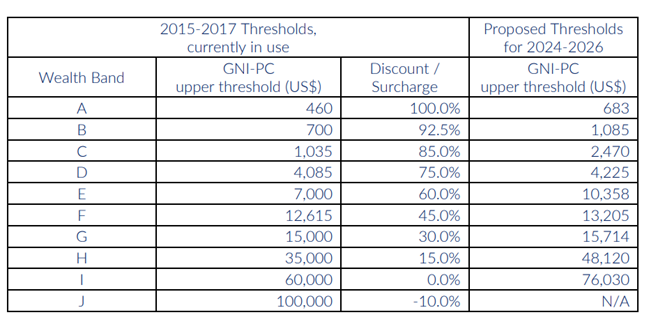
Proposed Motion 1.8 recommends moving to independently set wealth bands, based on World Bank income groups.
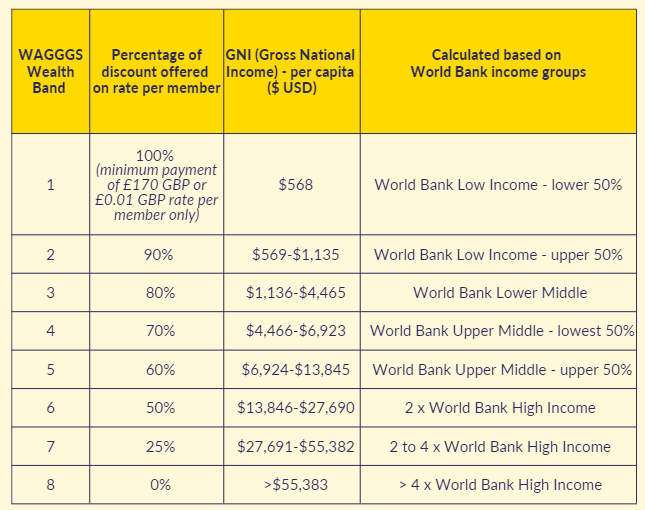
There are only four World Bank income groups, so it is proposed to subdivide some of these as described in the table above. For example, splitting World Bank income groups ‘Low Income’ and ‘Upper Middle’ into two and ‘High Income’ into three different groups. This is done in a way that can easily be adjusted in future years.
The three different groups have been set as:
- WAGGGS Wealth Band 6 - $13,846 to double the minimum threshold for World Bank ‘High Income’
- WAGGGS Wealth Band 7 - $27,691 to four times the minimum threshold for World Bank ‘High Income’
- WAGGGS Wealth Band 8 – Over $55,383 which is more than four times the minimum threshold for World Bank ‘High Income’
Does Proposed Motion 1.1 apply to new Component Associations within Federations?
No. The new Member benefit only applies to WAGGGS's Member Organisations (and therefore, in this case, the Federation, and not its Component Associations).
What are you trying to achieve by introducing a cap on the number of members counted in each Member Organisation's membership fee calculations across all wealth bands?
The World Board are seeking to smooth the transition for MOs moving between wealth bands. For example, the MO benefitting from the existing cap would find it extremely challenging to lose their benefit in full when they were no longer in wealth bands B-D.
Also, if the minimum £0.01 rate-per-member were to be adopted in Proposed Motion 1.4, then there are some large MOs who would benefit from the existing caps being extended to the lower Gross National Income groups.
A staggered application of this cap is therefore more future proofed for MOs and, in turn, WAGGGS’s longer-term sustainability.
Why are membership fees set for the triennium, and not annually?
WAGGGS uses a triennial strategic planning cycle and therefore it is helpful to have a three-year income projection to support this.
Setting membership fees on a triennial basis also allows Member Organisations time to plan their own finances to meet their respective fee obligations.
What could my membership fees be in 2025 2026, after the application of transitional relief?
During the Global Discussion Forum on Saturday 31 August 2024, we discussed individual Member Organisations' fees and the total membership fee income to WAGGGS, after the application of transitional relief.
The projected income for WAGGGS in 2025 and 2026, after the application of transitional relief, is approximately £1.6 million per annum. This impacts 2026 where the current MF policy was forecast to generate £1.7m income for WAGGGS. Based on feedback received from MOs during the MF review consultation, the World Board believes that it is more sustainable to have a slightly lower, but more achievable, membership fee to establish budgets.
If you would like to see membership fees in 2025 2026, with transitional relief applied, please click on this link. Please note that this data is based on the assumption that Proposed Motions 1.1 to 1.9 are adopted. If this is the case, transitional relief will be applied in 2025 and 2026 to support MOs with the change from the current MF policy to the new MF policy.
At what point in the fee methodology calculation is transitional relief applied?
After consultation and reflection, the Membership Fee Review Project Steering Group recommend all membership fee adjustments should be completed first and then, in a second stage, transitional relief be applied. This means that if Proposed Motion 1.7 is adopted, some MOs would not immediately reach the £0.01 minimum as they would benefit from the 100% cap being added to transitional relief. This helps to make any increases in fees more achievable.
This will be clearly articulated in the Membership Fee Policy which will be updated after the EGM.
Would a Member Organisation retain voting rights if the World Board agrees to reduce its membership fee in exceptional circumstances if Proposed Motion 1.6 (Flexibility to adjust fees on an individual basis) is adopted?
During the Global Discussion Forum on Saturday 31 August 2024, this question was raised and the expert panel present responded that the MO would retain its voting rights.
The Constitution states that "WAGGGS may require Member Organisations to pay reasonable membership fees to WAGGGS". Therefore, the World Board could, if Proposed Motion 1.6 is adopted, approve a reasonable fee adjustment and the Member Organisation would remain in good standing.